
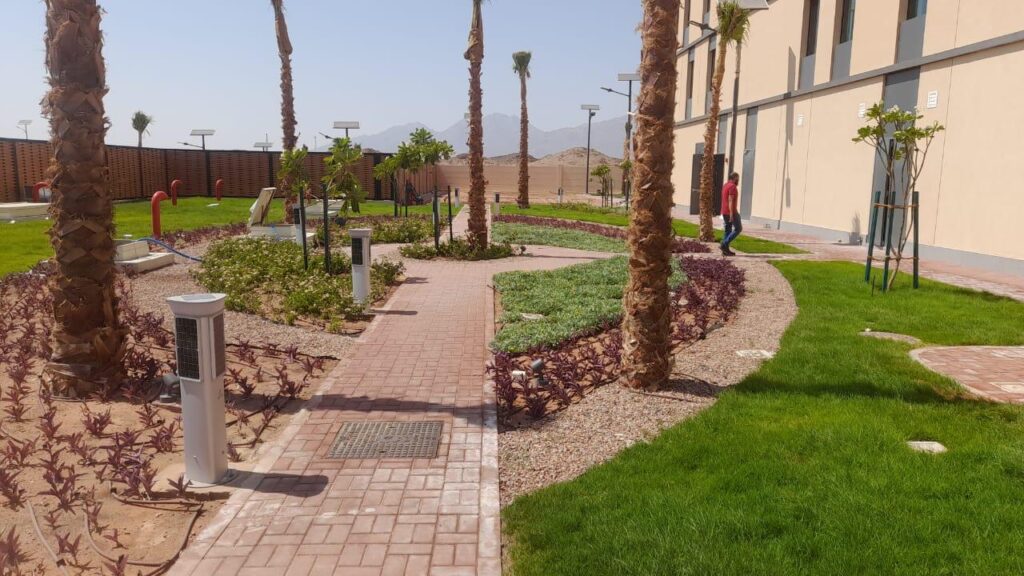
Great landscape design is rarely about plants alone or paving alone—it’s about how both systems work together. The most compelling gardens balance hardscape (built elements like paving, walls, decks) with softscape (plants, turf, soil, and living features) to create spaces that are functional, durable, and visually cohesive.
In climates like Riyadh, this balance is even more critical: materials must withstand heat and dust, while plant choices must be water-wise and resilient. Below is a practical, design-forward guide to combining hardscape and softscape effectively.
What’s the Difference?
Hardscape
- Paving (stone, concrete, porcelain)
- Retaining walls, steps, decks, pergolas
- Water features, fire pits, outdoor kitchens
Softscape
- Trees, shrubs, groundcovers, turf
- Soil systems and mulches
- Seasonal color and planting beds
Think of hardscape as the structure and softscape as the life layered onto that structure.
1) Start with a Clear Layout (Zoning First)
Before selecting materials or plants, define how the space will be used:
- Circulation (paths, entries, service routes)
- Social zones (seating, dining, BBQ)
- Quiet/green zones (lawns, planting beds)
Use hardscape to anchor these zones (patios, paths), then use softscape to soften edges and create transitions.
Pro tip: Sketch a simple plan with 60–70% hardscape in high-use areas and 30–40% softscape for greenery and cooling (adjust based on space size and climate).
2) Create a Visual Hierarchy (Focal Points)
Every garden needs a focal point:
- A feature tree
- A water element
- A sculptural wall or pergola
Use hardscape to frame the focal point (paving patterns, low walls), and softscape to highlight it (layered planting, color contrast).
3) Balance Materials and Textures
Contrast is what makes a design feel rich:
- Smooth pavers + soft grasses
- Rough stone + glossy-leaf shrubs
- Warm wood + cool-toned foliage
Avoid overusing one material. Limit your palette to:
- 2–3 hardscape materials
- 3–5 primary plant types (repeated for rhythm)
4) Design with Climate in Mind (Critical in Hot Regions)
In hot, arid environments:
- Choose light-colored paving to reduce heat absorption
- Use permeable surfaces where possible
- Prioritize drought-tolerant plants (native or adapted)
- Add shade structures (pergolas, trees)
Softscape should reduce heat and dust, while hardscape should withstand thermal stress.
5) Layer Your Planting (Depth & Structure)
Use a three-tier planting strategy:
- Canopy: trees for shade and structure
- Mid-layer: shrubs for volume
- Ground layer: groundcovers or gravel mulch
This layering integrates with hardscape edges and avoids the “flat garden” look.
6) Use Edging to Define Clean Transitions
Crisp boundaries make designs look intentional:
- Metal or stone edging between lawn and paving
- Raised planters against walls
- Gravel strips between structures and planting
Good edging prevents soil spillover, reduces maintenance, and sharpens the overall aesthetic.
7) Integrate Functional Elements Seamlessly
Hardscape often carries the “use” of the space:
- Seating walls
- Built-in planters
- Outdoor kitchens
Blend them with softscape:
- Plant climbers near pergolas
- Soften seating edges with low shrubs
- Use planters as transitions between zones
8) Think About Irrigation Early
Don’t treat irrigation as an afterthought:
- Separate zones for turf vs shrubs vs trees
- Use drip irrigation for planting beds
- Consider smart controllers to optimize water use
Designing irrigation alongside hardscape avoids costly rework later.
9) Lighting Should Support the Composition
Even if lighting isn’t your main topic, it’s essential for cohesion:
- Wash walls and textures (hardscape)
- Uplight feature trees (softscape)
- Light paths for safety
Keep it subtle—lighting should reveal, not overpower.
10) Maintenance Strategy = Design Quality
A beautiful design that’s hard to maintain will fail over time:
- Limit turf in hot climates
- Use mulch to reduce evaporation
- Select slow-growing, hardy plants
- Ensure access paths for cleaning and upkeep
Common Mistakes to Avoid
- Too much hardscape: feels hot and lifeless
- Too much softscape: lacks structure and usability
- No shade planning: unusable during daytime
- Poor drainage: leads to long-term damage
- Random plant selection: no cohesion or rhythm